
This post contains affiliate links. I may earn a commission if you purchase through these links, at no additional cost to you.
Introduction
Free traffic can help beginners promote affiliate content without spending money on paid advertising.
However, free traffic does not mean instant traffic.
Most free traffic methods require useful content, consistency, and time.
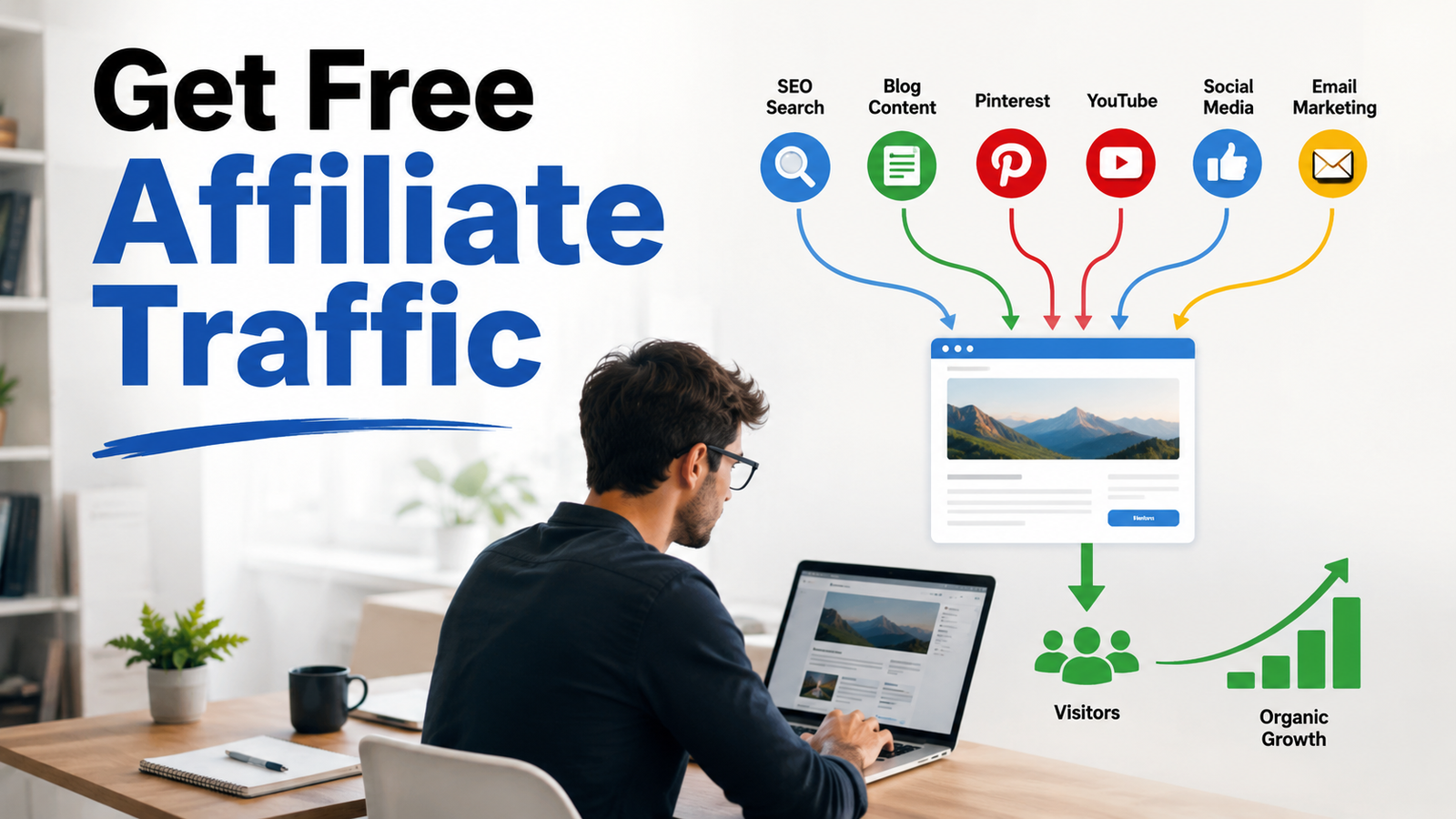
You can attract visitors through:
• Search engines
• YouTube
• Social media
• Online communities
• Email marketing
Each traffic source works differently.
For example, search engines may help people discover your articles when they look for answers.
Pinterest can help users find visual content and useful resources.
YouTube may allow you to explain products, demonstrate tools, or answer questions through video.
The goal is not to use every platform at once.
Instead, choose one or two traffic sources that fit your audience and content style.
Then, create helpful content that answers relevant questions.
For example, if your audience wants to learn about affiliate marketing, you can create beginner guides, tutorials, product reviews, and comparison articles.
As your content library grows, you may have more opportunities to reach new visitors.
Free traffic can take time to develop, but it may become a valuable part of a long-term affiliate marketing strategy.
In this guide, you will learn practical ways to get free traffic for affiliate marketing and improve your chances of reaching the right audience.
Understand Where Your Audience Searches
Before choosing a free traffic source, understand where your target audience looks for information.
Different people use different platforms based on what they want to find.
Someone searching for a detailed answer may use Google or another search engine.
Someone looking for visual ideas may use Pinterest.
Someone who wants to watch a demonstration may search on YouTube.
People may also discover helpful content through Facebook groups, online communities, or social media platforms.
Your goal is to choose traffic sources that match your audience and content format.
For example, if you create detailed affiliate marketing guides, search engine traffic may be a suitable option.
If your content includes tutorials, product demonstrations, or step-by-step explanations, YouTube may help you reach viewers.
If you create visual guides, checklists, or useful graphics, Pinterest may be worth exploring.
You do not need to publish on every platform.
Starting with too many traffic sources can make it difficult to stay consistent.
Instead, choose one main traffic source and learn how it works.
Then, create content that fits the platform and answers useful questions.
You can also review your results over time.
Look at which topics attract visitors, which pages receive clicks, and where your audience comes from.
This information can help you improve your content and focus on traffic sources that support your affiliate marketing goals.
Use SEO to Attract Organic Traffic
Search engine optimization, or SEO, can help your affiliate content appear when people search for relevant information online.
The first step is to understand what your audience wants to find.
For example, people may search for:
• How to start affiliate marketing
• Best affiliate programs for beginners
• How to choose affiliate products
• How to promote affiliate products
• Free traffic sources for affiliate marketing
These search topics can help you create content that answers real questions.
Before writing an article, choose a clear topic and focus on the search intent behind it.
Then, use the main keyword naturally in important areas, such as:
• The article title
• The introduction
• Relevant headings
• The URL slug
• The meta description
Avoid repeating the same keyword too often.
Instead, write clear content that explains the topic in a useful way.
You should also organize your article with descriptive headings and short paragraphs.
This can make the content easier for readers to scan and understand.
Internal links can also help visitors discover related guides on your website.
For example, you can connect beginner guides, affiliate program articles, product selection content, and promotion strategies.
SEO usually takes time.
However, useful and well-organized content may continue attracting visitors long after you publish it.
Create Helpful Blog Content
Helpful blog content can attract visitors by answering questions your audience is already asking.
Instead of writing only about affiliate products, focus on the problems people want to solve.
For example, you can create:
• Beginner guides
• Step-by-step tutorials
• Product reviews
• Comparison articles
• Problem-solving posts
• Frequently asked questions
Each article should have a clear purpose.
A beginner guide can explain a topic from the beginning.
A tutorial can show readers how to complete a specific task.
A product review can help potential buyers understand what a product does and whether it may fit their needs.
Try to make your content useful even before the reader sees an affiliate link.
Explain the topic clearly, answer important questions, and include practical information.
You can also connect related articles through internal links.
For example, a guide about choosing affiliate products can link to a related article about promoting those products.
This helps readers continue learning and discover more useful content on your website.
Do not focus only on publishing a large number of articles.
A smaller collection of useful, well-organized content can be more valuable than many short posts that provide little information.
Over time, updating older articles can also help you keep your content accurate and useful.
Use Pinterest for Search-Based Traffic
Pinterest can help people discover useful content through searches, visual recommendations, and related ideas.
Unlike many social platforms, Pinterest content may continue reaching users after it is published. A helpful Pin can direct people to your blog post, guide, tutorial, or product review.
To use Pinterest for affiliate marketing traffic, start by creating Pins that match the topic of your content.
For example, you could create Pins for:
• Affiliate marketing beginner guides
• Free traffic strategies
• Product reviews
• Step-by-step tutorials
• Affiliate marketing checklists
• Work-from-home content
Your Pin should clearly show what the reader will learn after clicking.
Use a simple headline that matches the article topic. Avoid using misleading text only to attract clicks.
You can also create more than one Pin for the same article. Each design can use a different headline or visual angle while linking to the same helpful page.
For example, one article about free affiliate traffic could use these Pin titles:
• 7 Free Ways to Get Affiliate Traffic
• How Beginners Can Get Free Website Traffic
• Free Traffic Strategies for Affiliate Marketers
Keep your Pin designs easy to read, especially on mobile devices.
Over time, consistent publishing and useful content can help you reach people who are interested in your topic.
Use YouTube to Reach New Audiences
YouTube can help you reach people who prefer watching videos instead of reading long articles.
You can create videos that answer common questions, explain useful tools, or demonstrate how a product works.
For affiliate marketing, useful video topics may include:
• Beginner tutorials
• Product reviews
• Product comparisons
• Step-by-step guides
• Tool demonstrations
• Common mistakes to avoid
Start by choosing a topic that matches a real question your audience may have.
For example, a beginner may search for a tutorial before deciding whether a product is suitable.
Your video can explain the topic, show the important details, and help viewers understand their options.
You can add a relevant link in the video description when it follows YouTube’s rules and fits the content.
However, avoid making the video only about selling a product.
Focus on providing useful information first.
You can also connect your YouTube videos with your website content.
For example, a video can introduce a topic, while a related blog post provides more detailed information.
This approach gives viewers another way to learn and may help bring relevant visitors to your website.
Consistency matters, but you do not need to upload every day.
A useful video that answers a specific question may continue reaching viewers over time.
Participate in Relevant Online Communities
Online communities can help you connect with people who are interested in your niche.
These communities may include:
• Facebook groups
• Reddit communities
• Online forums
• LinkedIn groups
• Niche discussion platforms
Before sharing your content, spend time understanding the community.
Read the group rules and observe the types of questions people ask.
Some communities allow helpful links, while others restrict promotional content or affiliate links.
Start by contributing useful information.
You can answer questions, share practical tips, and participate in relevant discussions.
For example, if someone asks how to get free traffic for affiliate marketing, you can provide a helpful answer based on your experience.
If your article gives additional information and the community allows links, you may share it when it genuinely helps the discussion.
Avoid joining a group and immediately posting your website links.
Repeated promotion can reduce trust and may lead to your posts being removed.
Focus on becoming a helpful participant.
Over time, people may visit your profile, explore your content, and learn more about your website.
The goal is to add value to the community, not to treat every discussion as a place to promote affiliate products.
Update and Improve Existing Content
Publishing an article is not always the final step.
Over time, you can review older content and look for ways to make it more useful.
Start by checking whether the information is still accurate and relevant.
You may need to update:
• Outdated statistics
• Product details
• Pricing information
• Screenshots
• Broken links
• Old recommendations
• Missing information
You can also review your website data to see which articles receive traffic and which pages need improvement.
For example, an article may attract visitors but receive very few clicks.
In that case, you could improve the headline, add clearer information, or make the next step easier to understand.
You may also find topics that need more detail.
Adding a useful section, answering a common question, or linking to a related guide can improve the reader’s experience.
Avoid changing content without a clear reason.
Instead, review the page, identify one or two useful improvements, and update the article carefully.
Regular updates can help you keep your content accurate and useful.
Over time, improving existing articles may be just as valuable as publishing new content.
Track Your Traffic Sources
Tracking your traffic sources can help you understand where your visitors come from and which promotion methods are working.
Your website analytics may show traffic from:
• Search engines
• Pinterest
• YouTube
• Social media
• Email campaigns
• Referral websites
Review this information regularly to identify useful patterns.
For example, one blog post may receive most of its visitors from Google, while another page may perform better on Pinterest.
This can help you understand which platforms match different types of content.
You should also look beyond total visitor numbers.
A traffic source may bring many visitors, but those visitors may leave quickly or show little interest in your content.
Another source may send fewer visitors who spend more time reading and click through to related pages.
These details can help you evaluate the quality of your traffic.
Use the information to make small improvements.
You may decide to create more content around a topic that performs well or improve an article that receives traffic but has low engagement.
Do not rely on one traffic source alone.
Over time, building traffic from several relevant sources can create a more stable affiliate marketing strategy.
How Long Does It Take to Get Free Traffic?
There is no fixed timeline for getting free traffic.
Some content may start receiving visitors within a few weeks, while other pages may take several months to gain attention.
The timeline can depend on:
• Your niche
• The competition for your topic
• The quality of your content
• Your chosen traffic source
• How consistently you publish
• How well your content matches audience needs
For example, search engine traffic may take time because new content needs to be discovered and evaluated.
Pinterest and social media may bring visitors sooner, but results can vary depending on the content and audience.
YouTube videos may also continue attracting viewers over time when they answer useful questions.
Instead of expecting immediate results, focus on creating helpful content and improving it when needed.
You may notice small signs of progress before receiving a large amount of traffic.
These signs can include:
• More search impressions
• A gradual increase in page views
• More clicks from social platforms
• Longer time spent on your content
Track your results and look for patterns over several weeks or months.
Free traffic often grows gradually.
Consistent content, useful information, and regular improvements can help you build a stronger long-term traffic strategy.
How This Guide Connects With Our Affiliate Marketing Guides
Getting free traffic is easier when you understand the complete affiliate marketing process.
If you are new to this business model, start with our guide on how to start affiliate marketing. It explains the basic process and the main steps involved.
After learning the basics, you can explore the best affiliate programs for beginners in 2026 to find programs that may fit your niche and goals.
Next, read our guide on how to choose affiliate products to promote. Choosing relevant products can help you create content that matches your audience’s needs.
If you want to begin with a limited budget, our guide on how to start affiliate marketing with no money explains how beginners can use free tools, content, and organic methods.
Once you have selected suitable products, our guide on how to promote affiliate products and get your first sale can help you create useful content and build trust with potential buyers.
Together, these guides follow a clear path:
Learn affiliate marketing → Find suitable programs → Choose relevant products → Start with limited resources → Promote products → Get free traffic
Frequently Asked Questions
What is the best free traffic source for affiliate marketing?
There is no single best source for everyone. Search engines may work well for detailed articles, Pinterest can support visual and search-based content, and YouTube may be useful for tutorials and demonstrations. The right option depends on your audience and content style.
Can I get affiliate traffic without paid ads?
Yes. You can use free methods such as SEO, blog content, Pinterest, YouTube, social media, online communities, and email marketing. These methods usually require time, consistent effort, and useful content.
How can beginners get free traffic?
Beginners can start by choosing one traffic source and creating content that answers relevant questions. It is often easier to focus on one or two platforms instead of trying to use every platform at the same time.
How long does free traffic take?
The timeline varies. Some content may receive visitors within a few weeks, while search-based traffic may take several months to grow. Results can depend on the topic, competition, content quality, and consistency.
Is SEO free traffic?
SEO does not require paying for every visitor, so it is commonly considered a free traffic method. However, creating useful content, improving your website, and maintaining your articles still require time and effort.
Can Pinterest send free traffic to an affiliate website?
Pinterest can help users discover blog posts, guides, tutorials, and other useful content. You can create relevant Pins that link to helpful pages on your website and follow Pinterest’s current rules for links and promotional content.
Should I use every free traffic source?
No. Using too many platforms at once can make it difficult to stay consistent. Start with one main traffic source, learn how it works, and expand when you have a manageable content process.
Why is my website not getting free traffic?
Your content may be new, the topic may be competitive, or the content may not match what people are searching for. Review your topic, search intent, content quality, promotion strategy, and website data before making changes.
Can free traffic lead to affiliate sales?
Free traffic can lead to affiliate sales when relevant visitors find useful content and discover products that match their needs. Traffic alone does not guarantee sales. Audience relevance, trust, product quality, and clear information also matter.
Final Thoughts
Free traffic can help you grow an affiliate marketing website without relying on paid advertising.
However, free traffic usually requires time, useful content, and consistent effort.
You can attract visitors through:
• Search engines
• Helpful blog content
• Pinterest
• YouTube
• Social media
• Online communities
• Email marketing
You do not need to use every traffic source at the same time.
Start with one method that fits your audience and content style.
Then, create helpful content that answers relevant questions and gives people a reason to visit your website.
Track where your visitors come from and pay attention to which topics perform well.
Over time, you can improve your existing content, test new ideas, and expand to other traffic sources.
Do not expect every article, video, or social post to generate immediate results.
Some content may take time to gain visibility.
A simple process can help:
Understand your audience → Choose a traffic source → Create helpful content → Share it consistently → Track results → Improve your strategy
Free traffic is not always fast, but it can support long-term affiliate marketing growth.
When you focus on useful content and the right audience, you can build a traffic strategy that continues to create opportunities over time.
Fast deposits and even faster withdrawals. That is all I really care about and this site delivers. br6733aa is my new go-to site.
[7895]co777 Official Login | Best Online Slots PH with GCash Bonuses,co777 offers seamless app downloads and expert guides on how to play baccarat. Enjoy fast GCash transactions and premium gaming. Join the action today! visit: co777
The bonuses for new players are actually generous. I felt welcomed from the moment I signed up. Check out phkkjili for some great promos.
I’ve tried a few different sites this month and this one stands out for its fairness. The wins feel genuine and the login is secure. Cheers to bolaslot88login.
[290]phcity Official Login | Legit Online Casino at Mabilis na GCash,phcity ang iyong gabay sa legit online casino. I-download ang app at alamin kung paano maglaro ng slots para sa pinakamabilis na gcash withdrawal. Mag-sign up na! visit: phcity
Perfect for sports fans. The live updates are spot on and the betting options are endless. I always use nbajjelogin for my weekly picks.
This site has a very chill vibe and the promotions are updated daily. It is a perfect way to unwind and try my luck at vnmh66.
I’ve tried a few sites lately but this one really stands out. The interface is super smooth and the payouts are legit. Definitely my new go-to spot. Check out selayar88slot for a great experience.
The app download was a breeze and it runs perfectly on my phone. Much better experience than the browser version. Check it out. x555comdownload
Best slot experience I have had in a while. The themes are great and the hit rate feels much better than other sites. Check out phslot777login now.
Such a fun community and the game selection is massive. I spend most of my free time here. You should check out phplaytimevicsotto.
The graphics are stunning and the gameplay is just seamless. I am really enjoying my time on novinetcasino.
Great variety of slots and the loyalty program is actually worth it. I’ve tried many others, but the stability here is unmatched. Big thanks to phssg777 for the great service.
The bonuses they offer for new players are legit and really give you a head start. I’m having a blast exploring the slots at vn5mm88
Honestly, the registration process was a breeze. I started playing within minutes and the graphics are top notch. Highly recommend it to anyone looking for a reliable platform. vnyly88
[8888]777joya Login at Register | Pinoy Slots GCash Deposit,Mag-777joya login app na para sa mabilis na register account. Subukan ang pinoy slots gcash deposit at download casino apk android. Sali na rito! visit: 777joya
The slot selection here is top notch. I hit a decent jackpot yesterday and the withdrawal was processed almost instantly. Love jili12345slot!
Really impressed with the interface here. Everything is laid out perfectly and the loading speeds are impressive. Great spot for anyone looking for a reliable site. c333com
If you love slots you cannot miss this one. The hit rate seems much better here than on other platforms I have used. Give balislot88 a try.
Quick deposits and even quicker withdrawals. It’s hard to find a site as efficient as 393betcc these days. Highly satisfied!
I’ve been playing here for a while now and the interface is super smooth. Definitely one of the best spots for gaming. Check out inyk777 for a great experience!